Language Groups
From the southern parts of Sydney down to the north-eastern parts of Victoria, there are four main languages on Yuin country. Whilst the languages have not been spoken fluently for some time, there is now a concerted effort by communities to revive language through education, arts and cultural practices.
The Working Group acknowledges that language is living and that various spellings have been used across time. For the purposes of this project and the associated dictionaries, the Working Group have agreed on the various spellings below to identify the different language groups.
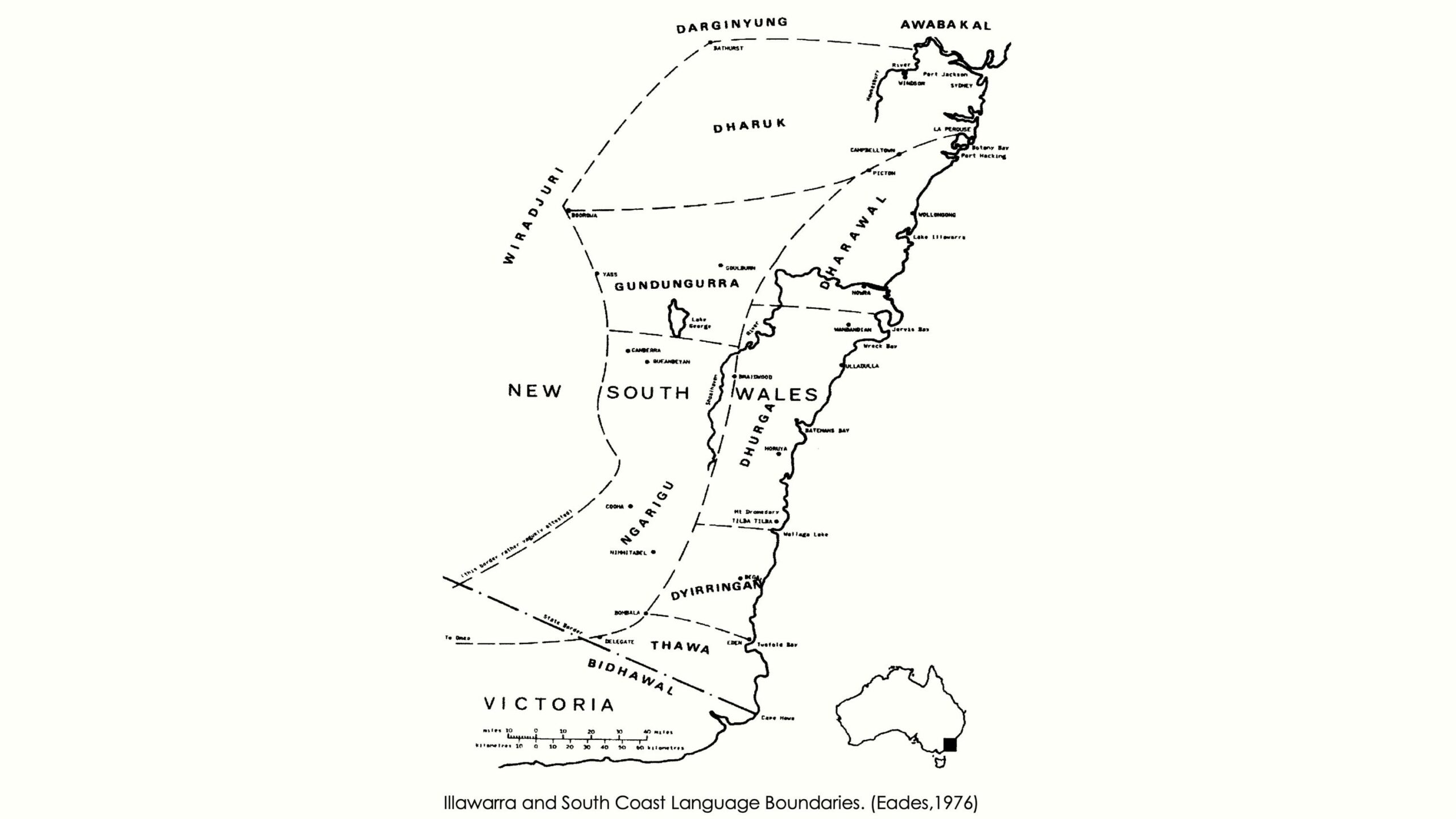
According to language information collected by various people between 1834 and 1902, the traditional languages of the New South Wales South-East Coast are defined as:
- Dharawal: The southern parts of Sydney and Botany Bay to Nowra
- Dhurga: South of Nowra to Narooma inclusive of Braidwood and Araluen
- Djiringandj: Narooma to Bega inclusive of Bermagui and Wallaga Lake and down to just north of Eden
- Dhawa: Eden to the north-eastern parts of Victoria
A dialect (regional variation) called Dharumba was spoken around Wandandian where the Dharawal and Dhurga merged. The names of other dialects are unknown.
Language Map
This language map was created by, and is published here with permission from, Dianne Eades. The borders of each language group on the map are considered to be fluid, because traditionally the languages overlapped each other.
South East Coast Place Names
| BEGA | big / beautiful camping ground |
| BERMAGUI | resembling a canoe with paddles |
| BIBBENLUKE | big lookout / place of birds |
| BODALLA | tossing a child up in the arms |
| TATHRA | haven for boats / several waters |
| BIMBIMBIE | place of many birds |
| BOMBALA | meeting of the waters |
| COBARGO | grandfather |
| COOMA | lake / sandbank / one |
| EUROBODALLA | small haven for boats / land between waters |
| ILLAWARRA | pleasant place near the sea |
| KAMERUKA | wait until I return |
| KIAH | beautiful place |
| KIANDRA | sharp stones used for knives |
| MERIMBULA | place of the big snake / place of two waters or lakes |
| MOGO | stone hatchet |
| MORUYA | water, ford |
| MONARO, MANEROO | plain / a woman's breast / the navel |
| NAROOMA | magic stone / sacred doctor stone / zamia palm growing in the water |
| NIMMITABEL | source of many streams |
| PAMBULA | two waters |
| QUAAMA | shallow water |
| TILBA TILBA | beautiful country / place of wild cats / many waters |
| ULLADULLA | safe harbour |
| WOMBOYN | male kangaroo |
| WOLUMLA | big swamps or waterhole |
| WANDANDIAN | home of the lost lovers |
